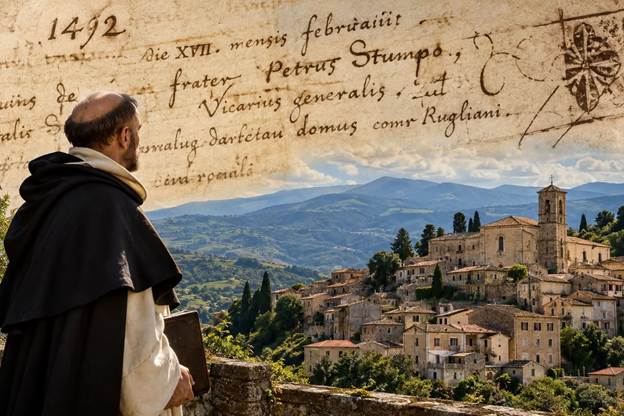
1492: The Terrible Stumbos
Working Manuscript
In 1492, Isabella of Castile and Ferdinand of Aragon were enjoying the usual advantages of monarchy—palaces, banquets, servants, lavish soirées and the comforting knowledge that God generally agreed with them. Their old Dominican confidant Tomás de Torquemada, Grand Inquisitor of Spain, was meanwhile experimenting with what might generously be described as an early ecclesiastical form of BDSM, except that consent had not yet made it into the theology. Torquemada had spent years worrying about Jews, Muslims, heretics and Christians who weren’t quite Christian enough, and he was one of the driving forces behind what became the Alhambra Decree. Ferdinand and Isabella signed it on March 31. Spain’s practicing Jews were given four months to convert or get out. By the beginning of August, families whose ancestors had lived on the Iberian Peninsula for centuries were walking toward ports and borders carrying whatever pieces of their lives they had been permitted to keep.
Nobody had a safe word.
And the year was only getting started.
Before Isabella and Ferdinand could start worrying about Jews, Columbus and whether the Atlantic Ocean had an end, they had another problem.
Granada.
Muslims had first crossed from North Africa into the Iberian Peninsula in 711. What followed was not 781 years of uninterrupted Muslim rule over Spain, but something considerably more complicated: conquest, caliphates, Christian kingdoms, alliances, betrayals, marriages, tributaries, holy wars and the occasional inconvenient tendency of Christians and Muslims to fight alongside one another against other Christians and Muslims.
By 1482, however, Ferdinand and Isabella had decided it was time to settle the matter.
What followed was the ten-year Granada War.
One by one, the remaining Muslim strongholds fell until only Granada remained—the last independent Islamic kingdom on the Iberian Peninsula.
Its ruler was Muhammad XII, whom the Spanish called Boabdil.
On 2 January 1492, Boabdil surrendered Granada to Ferdinand and Isabella.
Seven hundred and eighty-one years after Muslim armies first entered Iberia, the last Muslim kingdom was gone.
And 1492 was only two days old.
Ferdinand and Isabella were just getting started.
Torquemada had also been Isabella’s confessor and confidant, which put Ferdinand in what, five centuries later, we might delicately describe as a potential cuckold situation. There was the King, nominally running Spain, while another man enjoyed private audiences with his wife and spoke to her with the considerably greater authority of God.
And then there was Cristóbal Colón.
Our old Genoese-Portuguese-Spanish pal was somewhere around forty. Genoese, at least, was the convenient answer. It gave him a birthplace, tidied up the paperwork and saved everyone from asking too many questions about a man whose origins have been argued over ever since.
Cristóbal himself was less cooperative. He moved through the Iberian world, married into a Portuguese family, wrote mostly in Castilian rather than Italian, cultivated useful mysteries about himself and possessed the particular confidence of a man who had been told no for ten years and concluded that everyone else must be an idiot.
He was also spending an extraordinary amount of time trying to get Isabella’s attention.
Whether he ever got underneath the royal skirts is one of those small details history has inconsiderately failed to preserve.
Ferdinand may have wondered.
Torquemada may have wondered.
I certainly wonder.
Five centuries later, researchers would suggest that Columbus may even have carried Sephardic Jewish ancestry. The claim remains controversial, but for our purposes it adds precisely the sort of historical inconvenience Cristóbal seems to have specialized in.
Which allows us, with the irresponsible advantage of hindsight, to imagine Torquemada finally looking across the court at this suspiciously un-Genoese Genoese navigator still orbiting Isabella and thinking:
Enough already. Get his Jewish ass out of Spain.
There is absolutely no evidence that he said this.
Unfortunately for literature.
What we do know is considerably stranger. While Spain’s Jews were being driven toward its borders and ports, Columbus was preparing ships of his own. On August 3, 1492, he sailed west.
One way or another, everybody was leaving Spain.
WORKING DRAFT NOTE
This manuscript deliberately mixes documented history with clearly signaled literary speculation and satire. Claims concerning Columbus’s ancestry and personal relationships remain subjects for source verification as the manuscript develops.
Cristóbal sailed west with three ships and something like ninety men.
The Jews went the other way.
Once again, the stereotype of the Wandering Jew pops up. It is, after all, something of a trademark. Abraham wandered. Moses wandered. The Israelites wandered around the desert for forty years, apparently refusing to ask directions.
Whether any of that actually happened quite the way the Bible tells it is another matter.
Ramesses II usually gets dragged into the story because somebody has to play Pharaoh, and Yul Brynner looks good on the poster.
Apocryphal as it may be, it makes for a good story.
And good stories have a habit of repeating themselves.
Three thousand years later the Jews were leaving again. Different Pharaoh.
This time his name was Torquemada.
No Red Sea. No tablets. No burning bush. Just an Inquisitor, two Catholic monarchs and a piece of paper telling you that after generations of living in Spain, God had apparently changed the locks.
So they wandered.
How many is one of those questions historians have been arguing about ever since. Forty thousand. Fifty thousand. A hundred thousand. Two hundred thousand. The people standing on the docks probably weren’t counting.
They hightailed it east across the Mediterranean, carrying children, family names, languages, recipes, trades, grudges, God and whatever money Ferdinand and Isabella had failed to separate them from.
Cristóbal went west looking for the Indies.
The Jews went east looking for Chinese take-out.
Everybody had a travel agent in 1492.
Nobody had a return ticket.
So here are the players.
Ramesses and Moses. Torquemada and Abraham. Isabella and Colón. Ferdinand of Aragon and Ferrante of Naples. Jews going east. Cristóbal going west. Everybody convinced God was traveling with them.
Which means sooner or later we have to talk about the man supposedly holding God’s passport.
The Pope.
In 1492, that job belonged—eventually—to Rodrigo Borgia, better known as Pope Alexander VI. Spaniard. Politician. Father of several children despite that inconvenient business about clerical celibacy. A man whose family name would eventually become shorthand for practically everything the Renaissance Church preferred not to put in the brochure.
Alexander wasn’t Pope when our story opened in January. Innocent VIII was. Innocent died on July 25, right in the middle of our increasingly ridiculous summer. Rodrigo Borgia was elected on August 11, eight days after Colón sailed west.
And operating within this same Church was a particularly energetic collection of men dressed in white robes and black cloaks.
The Order of Preachers.
The Dominicans.
Torquemada was one.
And several months earlier, on February 17, 1492, down in Calabria, another Dominican had put his authority behind the establishment of a convent in the little town of Rogliano.
His name was Fra Pietro Stumpo.
His title was Vicar General — “Vicario generale della suddetta Provincia” — which is where this story becomes personal.
So who was Pietro?
I’ll get to that.
First, let’s go up the ecclesiastical food chain and talk about who was Pietro’s boss?
Here we have a very good answer.
The head of the entire Dominican Order in 1492 was Fra Gioacchino Torriani—Joachim Torriani, Joaquín Torriani, depending on who was holding the pen.
Notice how a small inconsistency in spelling can alter a name?
We might want to remember that.
Torriani was a Venetian. He had been elected Master General of the Order of Preachers in 1487 and would remain in that position until his death in 1500. A General Chapter of the Dominicans was held at Le Mans in 1491, the year immediately before our man Pietro turns up in Rogliano.
And Torriani is interesting.
He wasn’t merely an administrator.
He was a theologian.
And, because apparently nobody in this story can simply have a normal job, he was also a former inquisitor.
Everybody’s got a side gig.
Torriani had served as an inquisitor in Vicenza and would later become involved in the proceedings surrounding Girolamo Savonarola, the Dominican friar who managed the remarkable career trajectory of preacher, political revolutionary, religious reformer, excommunicate and, finally, kindling.
Put that in your pipe and smoke it.
The Witch Trials in Salem got their handbook from somebody.
But that’s getting ahead of ourselves.
In February of 1492, Fra Gioacchino Torriani was running the Dominicans.
And somewhere beneath him in that ecclesiastical food chain was a Vicar General named Fra Pietro Stumpo.
Stumpo. Stumbo. Stummo.
Depending, perhaps, on who was holding the pen.
There is another small problem with our man Pietro.
His name is Stumpo.
Mine is Stumbo.
One letter.
Five hundred years.
This should not surprise us too much.
Southern Italians in the old days weren’t particularly enthusiastic about writing things down themselves. That was what priests, monks and notaries were for. Nor were they walking around Calabria speaking the nice standardized Italian you hear on television today. They spoke local languages and dialects—layer upon layer of Latin, Greek and whatever else had washed ashore during the previous two thousand years.
Then somebody had to write down what he thought he heard.
Which brings us to the difference between a B and a P.
Not much.
Linguistically, B and P are essentially the same physical consonant with one important difference: B is voiced and P is unvoiced. Put your lips together and make a B. Now make a P. Same machinery. Turn the vocal cords on or off.
As Lauren Bacall so famously explained, “You know how to whistle, don’t you, Steve?”
Put your lips together and blow.
Imagine that passing from a Calabrian farmer to a priest, from a priest to a notary, from one dialect to another, and then across several centuries of handwriting by men who had never heard of spellcheck.
Stumbo. Stumpo.
It doesn’t require an Ellis Island clerk or some great family reinvention. It may require nothing more dramatic than one man saying his name and another man deciding how to spell it.
And southern Italian dialect gives us another little trick. The consonants can assimilate:
Stumbo becomes Stummo.
So now we have Stumpo, Stumbo and Stummo wandering around Calabria along with everybody else.
Which doesn’t prove that Fra Pietro Stumpo was my ancestor.
Not even close.
But I like the hardcore Dominican wanker.
Ballsy move, going down to Rogliano and founding a convent.
In modern terms, it’s kind of like me coming to Costa Rica and opening—I don’t know—a strip club.
Different habits.
Same entrepreneurial spirit.
But it does make it considerably harder to dismiss the possibility simply because somebody changed a P into a B.
Five hundred years is a long time to expect everybody to spell your name correctly.
Especially when most of them weren’t asking you.
So who was Pietro?
I’ll get to that.
First, let’s go up the ecclesiastical food chain and talk about who was Pietro’s boss?
Here we have a very good answer.
The head of the entire Dominican Order in 1492 was Fra Gioacchino Torriani—Joachim Torriani, Joaquín Torriani, depending on who was holding the pen.
Notice how a small inconsistency in spelling can alter a name?
We might want to remember that.
Torriani was a Venetian. He had been elected Master General of the Order of Preachers in 1487 and would remain in that position until his death in 1500. A General Chapter of the Dominicans was held at Le Mans in 1491, the year immediately before our man Pietro turns up in Rogliano.
And Torriani is interesting.
He wasn’t merely an administrator.
He was a theologian.
And, because apparently nobody in this story can simply have a normal job, he was also a former inquisitor.
Everybody’s got a side gig.
Torriani had served as an inquisitor in Vicenza and would later become involved in the proceedings surrounding Girolamo Savonarola, the Dominican friar who managed the remarkable career trajectory of preacher, political revolutionary, religious reformer, excommunicate and, finally, kindling.
Put that in your pipe and smoke it.
The Witch Trials in Salem got their handbook from somebody.
But that’s getting ahead of ourselves.
In February of 1492, Fra Gioacchino Torriani was running the Dominicans.
And somewhere beneath him in that ecclesiastical food chain was a Vicar General named Fra Pietro Stumpo.
Stumpo. Stumbo. Stummo.
Depending, perhaps, on who was holding the pen.
Cosenza
Across the Calabrian Apennines, Belvedere Marittimo and Rogliano aren’t particularly far apart.
Today it’s about eighty-five kilometers by road. In 1492 there were no highways, tunnels or helpful signs pointing toward Cosenza. There were mountain roads, mule tracks and whatever directions you could extract from the guy coming the other way.
A Stumbo—or a Stumpo—on a mule could probably make the journey in a couple of days.
That interests me.
Belvedere Marittimo, sitting on the Tyrrhenian coast, is where I can document the Stumbo family by the middle of the eighteenth century. Rogliano, across the mountains to the southeast, is where Fra Pietro Stumpo turns up more than two and a half centuries earlier.
Sixty-two kilometers as the crow flies.
A couple of days by mule.
And 261 years still missing from the family tree.
By the time my Stumbos were firmly planted in Belvedere, they were a close-knit bunch. They liked marrying the Marino, De Luca and Ferraro girls from the village. The men kept recycling names like Raffaele, Filippo, Vincenzo and Luca as though somebody were charging extra for originality.
The women weren’t much better.
Maria. Angela. Innocenzia. Giovanna.
There was even an ancient Biagio Stumbo who died in 1847 at about eighty years old, which puts him wandering around Belvedere sometime around 1767.
Dinner parties must have been complicated.
“Raffaele!”
Four men look up.
“Maria!”
Half the women leave the kitchen.
Somewhere in all those Pietros, Raffaeles, Filippos, Vincenzos, Marias and Giovannas is the reason my name exists.
The question is whether one of them—or one of their ancestors—ever threw a leg over a mule and headed across those mountains toward Rogliano.
Who Exactly Was Our Man Pietro?
So who exactly was our man Pietro?
For the moment, history gives us one beautifully irritating answer: important enough to leave a mark, but not considerate enough to leave a biography.
On February 17, 1492, Fra Pietro Stumpo appears at Rogliano as Vicar General of the Dominican organization in Calabria, lending his authority to the establishment of the convent of San Domenico in the little church of Santa Maria di Caporota. We know this because a Dominican report written in 1650 says the friars still had an older document recording the foundation and, before the earthquake of 1638 knocked the place apart, a stone inscription carved into the main arch of the church had said essentially the same thing.
That is not family legend. That is paperwork and stone.
Unfortunately, neither tells us where Pietro came from.
He may have been from Rogliano. He may have been from somewhere else in Calabria. He may have ridden into town on the same miserable mountain tracks I have been imagining my Stumbos crossing from Belvedere. At the moment, we simply don’t know.
But Pietro was not some anonymous monk sweeping the cloister.
A Vicar General was a senior Dominican official. Above him, in 1492, sat Fra Gioacchino Torriani, the Venetian Master General of the entire Order of Preachers. Torriani had been running the Dominicans since 1487. Which means that while Torquemada was making Spain unpleasant for practically everyone and Cristóbal Colón was pestering Isabella for boats, our Pietro was operating inside the same international Dominican machine.
And that machine kept records.
Five centuries later, some of them are still sitting in Rome in the Archivum Generale Ordinis Praedicatorum. Better yet, a Dominican scholar named Benedictus Maria Reichert published Torriani’s surviving registers in 1914. The relevant volume covers 1491 to 1494—the exact years surrounding Pietro’s appearance at Rogliano.
So now Pietro has gone from being a ghost in a seventeenth-century report to being a man who may be hiding somewhere in a fifteenth-century administrative ledger.
This is the peculiar pornography of genealogy.
Normal people see an old Latin register and go to lunch.
I see the possibility of one line:
Frater Petrus Stumpo de ______.
Brother Pietro Stumpo of somewhere.
Fill in that blank and suddenly we know where he belonged. Rogliano. Cosenza. Belvedere. Altomonte. Some village I haven’t even heard of yet.
The Calabrian historian Luigi Guglielmo Esposito spent years in these Dominican archives and published I Domenicani in Calabria: ricerche archivistiche in 1997. His work, and the surviving Torriani registers, tell us that this is no longer a search for a mythical ancestor floating around medieval Calabria.
There is a file cabinet.
Admittedly, it is a five-hundred-year-old ecclesiastical file cabinet written largely in Latin and maintained by dead Dominicans.
But I’ll take it.
Meanwhile another problem has appeared. Stumpo did not vanish from Rogliano after Pietro. By the eighteenth century there were multiple Stumpo households there, and in 1752 the state archive at Cosenza records another Pietro Stumpo signing marriage articles with Innocenza Greco.
Another Pietro.
Of course.
So much for clerical celibacy.
If my genetic markers originated with old boy Pietro, our man on the scene was apparently pretty busy in the convent.
Well then again, maybe not.
Dinner parties must have been complicated in Rogliano too.
None of this proves that Fra Pietro belongs to my Stumbos of Belvedere. Not yet. A Dominican friar is not exactly the ideal candidate for producing a long line of legitimate descendants, although given what we already know about the Renaissance Church, I am reluctant to rule out anything on professional grounds.
What it does prove is more interesting.
In 1492, the name Stumpo was already alive in the same small corner of Calabria where, centuries later, Stumbos and Stumpos would continue turning up.
And somewhere between Pietro’s convent in Rogliano and my family in Belvedere there are 261 years of missing people.
We are going looking for them.
There was, however, another man standing in Pietro’s chair before Pietro got there.
His name was Fra Vincenzo de Texano.
On May 29, 1490, less than two years before Pietro turns up in Rogliano, Vincenzo was prior of the Dominican convent at Altomonte. Gioacchino Torriani appointed him Vicar General of the reformed Dominican convents of Calabria, with what the Latin rather impressively describes as plenaria auctoritate.
Full authority.
Apparently the Dominicans didn’t believe in easing a man into management.
Then Vincenzo disappears from our story.
Twenty months later, there is Pietro Stumpo standing in Rogliano carrying what appears to be essentially the same job.
Naturally, I want to know what happened to Vincenzo.
Maybe he died.
People did that with considerable enthusiasm in the fifteenth century.
Maybe his term simply ended. Maybe Torriani transferred him somewhere else. Maybe he got tired of managing a collection of argumentative Calabrian monks and decided that whatever came after this life couldn’t possibly be worse.
Or maybe there was a scandal.
I prefer the scandal.
Unfortunately, history has so far refused to cooperate.
I haven’t found Vincenzo dead, disgraced, defrocked, imprisoned, sleeping with the abbess next door or caught selling communion wine out the back door of the convent.
Nothing.
But we know such things weren’t entirely foreign to this particular organization.
A few years after Pietro, another Calabrian Vicar General named Giovanni Battista di Crotone managed to get himself investigated seriously enough that Rome sent two visitors down to Calabria in 1498 to find out what the hell was going on. Whatever Giovanni Battista had been accused of, the investigators eventually reported favorably and Torriani put him back in charge.
So these were not monks quietly growing tomatoes.
There was politics.
There were factions.
There were investigations.
There were men being appointed, removed, examined and restored.
And somewhere between Vincenzo de Texano on May 29, 1490, and Pietro Stumpo on February 17, 1492, the chair changed occupants.
That interests me almost as much as Pietro himself.
Because appointments generally leave paperwork.
Dismissals leave paperwork.
Scandals leave wonderful paperwork.
And dead men, sooner or later, leave paperwork too.
Somewhere in the Dominican archives there may be a sentence explaining precisely why Vincenzo disappeared and our boy Pietro walked onto the stage.
Until we find it, I am resisting the temptation to invent a Dominican sex scandal.
Barely.
An Unholy Alliance
While the Dominicans were apparently rearranging the furniture down in Calabria, the people above them were rearranging Europe.
Pope Innocent VIII and Ferrante, King of Naples, had spent much of the previous couple of years behaving like men who might eventually have to kill each other.
The Pope had threatened Ferrante with excommunication and the Kingdom of Naples with an interdict. Ferrante, who had never been particularly impressed by threats, had his own ideas about who should be telling whom what to do.
Then something remarkable happened.
They became friends.
Or at least the fifteenth-century version of friends.
On January 27, 1492, a peace agreement between Naples and the Holy See was announced in Rome.
On February 7, it was formally ratified.
And because apparently a treaty wasn’t enough to convince anyone that these two men had stopped plotting against each other, they decided to become family.
Ferrante had a grandson.
Innocent had a niece.
Problem solved.
The grandson was Luigi d’Aragona, Marquis of Gerace.
The niece was Battistina Usodimare.
The marriage was arranged as part of the new understanding between Naples and Rome, and on June 3, 1492, Luigi and Battistina were married in the Vatican with the Pope presiding over the festivities.
In-laws.
Outlaws.
And the Holy See.
You couldn’t make this shit up.
Well, you could.
But apparently you didn’t have to in 1492.
The marriage wasn’t merely romantic window dressing. Ferrante wanted the papacy to recognize the Aragonese succession to the Kingdom of Naples. Innocent wanted security for the Papal States and a settlement with the troublesome old bastard sitting on the throne to his south.
So they did what powerful families have been doing since somebody invented property.
They married the children.
Technically the grandchildren.
Same racket.
And here’s where my interest becomes unhealthy.
The treaty was ratified on February 7.
Ten days later, on February 17, Fra Pietro Stumpo appears in Rogliano carrying the title of Vicar General.
Meanwhile his predecessor, Fra Vincenzo de Texano, has vanished from our paperwork.
Does this mean the Pope had anything to do with Pietro’s appointment?
No.
Does it mean Ferrante did?
No.
Does it mean Vincenzo had somehow found himself on the wrong side of the reconciliation between Naples and Rome?
Absolutely no evidence whatsoever.
But ten days is ten days.
And when a Pope and a King who have spent two years threatening each other suddenly shake hands, marry their families together and begin reorganizing their political relationship while somebody down in Calabria quietly changes the man running the Dominicans, I reserve the right to raise an eyebrow.
This is not evidence.
This is circumstantial evidence.
Which is considerably more fun.
Somewhere between the King of Naples, the Holy See, Gioacchino Torriani, Vincenzo de Texano and our increasingly interesting Fra Pietro Stumpo, there may be absolutely nothing.
Or there may be a story.
The documents will decide.
Assuming the bastards left us any.
Puglia Power-Play and the Dancing Dominicans of Calabria
The reform had begun because apparently the Dominicans needed reforming.
This is rarely a promising sentence.
The idea was Observance.
Back to the Rule. Back to discipline. Back to poverty, prayer, study and the austere religious life Saint Dominic presumably had in mind before several generations of Italians got hold of it.
In Calabria, Fra Paolo da Mileto led the charge.
Perfect observance.
No more fucking around.
Unfortunately, these were Calabrians.
The historical record contains a phrase I couldn’t possibly improve upon. The friars displayed a certain:
particolare vivacità e tendenza alla trasgressività.
A particular liveliness and tendency toward transgression.
Now we’re getting somewhere.
Exactly what they were transgressing remains to be determined. Rules? Authority? Poverty? Each other? The historical record has so far been annoyingly discreet.
But somebody had decided these men required reform, and reform meant discipline. The new Observant congregations weren’t created so everybody could have a more relaxed afternoon. They were intended to make Dominican life stricter.
Which brings us back to the increasingly interesting question of our boy Pietro.
Maybe Pietro wasn’t merely another monk whose turn came up.
Maybe he was management.
Maybe Fra Pietro Stumpo was the Dominican equivalent of J. Edgar Hoover—the hard-ass sent into Calabria to straighten out a collection of friars exhibiting an inconvenient tendenza alla trasgressività.
I like this Pietro considerably more.
Unfortunately, liking him doesn’t make it true.
Yet.
What we actually have is a succession of men occupying a surprisingly important chair: Francesco di Altomonte, Vincenzo de Texano and then Pietro Stumpo. And they appear to be moving through it quickly enough to make me suspicious.
Francesco goes.
Vincenzo arrives.
Vincenzo disappears.
Pietro takes the chair.
All while the Dominican reform movement is trying to impose discipline on Calabria, the Pope and the King of Naples are alternately threatening and marrying into each other’s families, and the Calabrian brothers themselves have acquired a historical reputation for a tendency toward transgression.
Maybe Pietro was elected because everybody loved him.
Maybe he was elected because nobody else wanted the job.
Or maybe Gioacchino Torriani looked south, surveyed the situation and decided Calabria needed a son of a bitch.
And found himself a Stumpo.
That last possibility is considerably more satisfying.
It is also, at the moment, completely circumstantial.
So we keep digging.
Forgive Us Our Trespasses
So what exactly were these guys doing?
This seemed like a reasonable question.
The historical description is wonderfully suggestive. The Calabrian friars had developed what their superiors apparently regarded as a particolare vivacità e tendenza alla trasgressività.
A particular liveliness and tendency toward transgression.
That’s not the sort of sentence you normally find in the employee handbook.
Naturally, my first thought was sex.
Maybe Vincenzo de Texano wasn’t removed from office.
Maybe he was exhausted.
Maybe the whole Calabrian congregation had turned into one enormous fifteenth-century booty-release party and Gioacchino Torriani finally decided somebody had to put his pants back on and answer the correspondence.
Unfortunately, the documents aren’t giving me that.
What they are giving me is politics.
The Dominican reform movement in southern Italy wasn’t one big happy family of newly disciplined monks marching obediently back toward Saint Dominic.
They fought.
The reformers divided into factions. One Observant group could find itself in conflict with another. Masters General intervened, issued decisions, discovered that the friars didn’t particularly like those decisions and occasionally had to reverse themselves.
Harmony, according to the historians, was not exactly their strong suit.
Which makes the revolving chair in Calabria considerably more interesting.
Francesco di Altomonte.
Vincenzo de Texano.
Pietro Stumpo.
Three men passing through the office of Vicar General while the Calabrian Dominicans were simultaneously attempting stricter religious observance and exhibiting a documented tendenza alla trasgressività.
Maybe they weren’t fucking around.
Maybe they were just fucking with each other.
Either way, somebody eventually put our boy Pietro in charge.
And I still want to know why.
Fra Pietro Stumpo was a Dominican.
Which means, among other things, he was supposed to be celibate.
I mention this because approximately two and a half centuries later Rogliano appears to be crawling with Stumpos.
Bruno Stumpo.
Francesco Stumpo.
Gaetano Stumpo.
Giacomo Stumpo.
Giuseppe Stumpo.
Stefano Stumpo.
And in 1752, because apparently God has a sense of humor, another Pietro Stumpo turns up signing marriage articles with a woman named Innocenza.
Innocenza.
You couldn’t give me a better name if I were making this shit up.
Did our Dominican Pietro single-handedly populate Rogliano with Stumbos?
Absolutely no evidence whatsoever.
Two hundred and sixty years is a very long gap. Those later Stumpos could have descended from Pietro’s brothers, cousins, another local Stumpo family or people who arrived long after he was gone. We don’t even know that Fra Pietro was born in Rogliano.
But considering the documented tendenza alla trasgressività of the Calabrian Dominicans, I’m not taking him off the board.
Forgive us our trespasses indeed.
The Revolving Chair
The more I looked at Fra Pietro Stumpo, the stranger his job became.
In 1489, Gioacchino Torriani reorganized the Dominican reform movement in southern Italy into three Nations: Puglia, Calabria and Terra di Lavoro.
Each was to have a Vicar General.
The rules were surprisingly specific. The Vicar was to be elected every three years, on the prescribed Sunday after Easter.
Three years.
Simple enough.
Except apparently nobody told the Calabrians.
In August 1489, Fra Francesco di Altomonte was made Vicar General of Calabria.
Nine months later he was gone.
On May 29, 1490, Fra Vincenzo de Texano had the job, with what the documents describe as plenaria auctoritate.
Full authority.
That sounds impressive.
It also didn’t last very long.
By February 17, 1492, Vincenzo had disappeared from the chair and our boy Pietro was sitting in it.
Three Vicars in less than three years.
For an organization devoted to stability, obedience and perfect religious observance, these guys were changing management like a restaurant in Jacó.
Something was happening.
I just don’t know what.
Francesco may have died.
Vincenzo may have resigned.
Somebody may have promoted him, transferred him, removed him or simply decided that full authority had been a terrible idea.
The documents I can presently see don’t tell us.
What they do tell us is that when the Dominicans needed somebody running Calabria in February 1492, the man holding the keys was Fra Pietro Stumpo.
And then things become even more interesting.
Because Pietro’s chair came with an expiration date.
Or at least an election date.
Torriani’s rules called for another election three years later.
1495.
So I went looking for it.
And disappeared down the rabbit hole.
The original register of the Master General still exists in Rome.
AGOP IV.11.
The surviving entries cover precisely the period we’re interested in. We can follow Torriani’s correspondence through the spring of 1495. We even have a letter dated May 7 sitting around folio 66.
And somewhere around that neighborhood should be one of the most interesting sentences in this entire ridiculous investigation.
Who became Vicar General of Calabria in 1495?
Was Pietro reelected?
I don’t know.
Yet.
But I can’t find anybody replacing him.
I searched Pietro forward.
Nothing.
I searched his successor backward.
Nothing.
I searched Stumpo, Stumbo, Stumpus, Petrus Stumpo, vicarius generalis, Nationis Calabriae, elections, confirmations, convents and every conceivable combination of badly digitized Latin that might conceal a five-hundred-year-old Calabrian Dominican.
Nothing.
Which proves precisely nothing.
The published digest of Torriani’s register isn’t complete. Modern historians have gone back to the original manuscript and found material the printed summaries don’t give us.
The answer may therefore be sitting on a piece of paper in Rome approximately six centuries old, possibly within a handful of folios of where we’re already looking.
Genealogy has its own peculiar pornography.
This is mine.
One line.
Frater Petrus Stumpo confirmatur Vicarius Generalis Nationis Calabriae.
That’s all I want.
Because if something resembling that sentence exists in 1495, our boy Pietro didn’t merely pass through the office.
He survived.
Three Years Later
By 1498 somebody else was sitting in Pietro’s chair.
Fra Giovanni Battista di Crotone.
And apparently things were going badly.
Very badly.
The surviving history describes peripezie e severe inchieste.
Misadventures and severe investigations.
Now we’re talking.
Whatever Giovanni Battista had done—or whatever somebody claimed he had done—was serious enough that Rome sent two visitors to Calabria during the summer of 1498 to investigate.
Two guys from Rome.
They came south.
They investigated.
They reported back.
And Giovanni Battista was eventually rimesso in carica con ogni facoltà.
Restored to office with all his powers.
Which means somebody had taken those powers away.
Why?
I don’t know that either.
This entire story seems determined to give me precisely enough evidence to become suspicious and never enough to call a witness.
But Giovanni Battista creates another problem.
When did he replace Pietro?
If Giovanni Battista became Vicar in 1495, then Pietro probably served one three-year term and disappeared.
If Pietro was reelected in 1495, however, then Pietro may have run the Calabrian Dominicans for approximately six years—from 1492 until the next scheduled election in 1498.
And that changes him.
A three-year Vicar might simply have taken his turn.
A six-year Vicar who survived a congregation of lively, transgressive Calabrian Dominicans during the French invasion of southern Italy is somebody I want to know considerably better.
Especially because the next man apparently required an investigation from Rome.
So somewhere between Pietro Stumpo and Giovanni Battista di Crotone there is another missing piece of paper.
I’m beginning to take this personally.
Dominicans, Women and Song
What brought Fra Pietro Stumpo to the head of the Calabrian Dominicans in 1492 is still something of a mystery.
What we know is that the Dominican organization he governed had been created as part of the Observant reform movement. Its purpose was not simply administration. Observance meant bringing friars back under the discipline of the Order—obedience, communal life, poverty, chastity and, when necessary, the correction of brothers whose interpretation of those obligations had become excessively imaginative.
By February 17, 1492, Pietro Stumpo was Vicar General. On that date he appears in the surviving account of the foundation of the Dominican convent at Rogliano, giving his assent to the establishment of the new house at Santa Maria di Caporota. The seventeenth-century friars who recorded the event said they were working from an older document preserved in the convent and from an inscription that had once stood in the church. The original records were subsequently lost in the catastrophic Calabrian earthquake of 1638.
What we do not yet possess is the document appointing Pietro.
That distinction matters.
We cannot say that Pietro was sent to Calabria because the friars had been drinking, gambling, chasing women, fathering children or otherwise demonstrating that the vows of poverty, chastity and obedience were being treated more as suggestions than commandments. We have not found evidence establishing any of those things about Pietro’s Calabrian friars.
But neither have we been able to eliminate reasonable doubt.
The surviving Dominican records show that the reform authorities of this period were decidedly interested in what their friars were doing when nobody was looking. They pursued wandering and disobedient brothers, threatened imprisonment, controlled contact with women and regulated who could hear women’s confessions.
One regulation is particularly difficult to improve upon.
In 1496 Dominican authorities at Viterbo prohibited friars under the age of forty from hearing the confessions of women.
Forty.
Apparently thirty-nine was still dangerous territory.
The rule itself does not prove that anybody had been caught doing anything. Medieval religious legislation was frequently preventative, and it would be irresponsible to manufacture a sexual scandal merely because the regulation makes one irresistible to imagine.
Still, somebody thought the rule was necessary.
There is something wonderfully peculiar about constructing a small dark compartment in which a woman whispers her most intimate sins to a celibate man through a screen, and then deciding that the arrangement is perfectly safe provided the man on the other side has celebrated his fortieth birthday. The medieval confessional already possessed most of the architectural prerequisites of a glory hole. The Dominicans apparently supplied the age restriction.
None of this proves that Fra Pietro Stumpo was dispatched to Calabria as an ecclesiastical sheriff. It does, however, place him in the leadership of an organization explicitly devoted to reform at precisely the moment when Dominican superiors elsewhere were policing obedience, mobility, money, women and sexual propriety.
So until Pietro’s appointment letter turns up, the case remains circumstantial.
Perhaps Fra Pietro was simply a competent administrator who happened to become Vicar General.
Perhaps he was elected because the Calabrian Observants needed somebody capable of keeping the brethren observant.
And perhaps somewhere in the registers in Rome there is a line explaining exactly why.
For the moment, history has not convicted the Calabrian Dominicans of turning their convents into massage parlors.
But it hasn’t eliminated reasonable doubt either.
And all of that being said, I am still not entirely certain that Fra Pietro didn’t single-handedly populate Rogliano with Stumpos.
If it was good enough for the Vatican, why wasn’t it good enough for Calabria?
BACK TO THE FUTURE — 1752
Two hundred and sixty years after Fra Pietro Stumpo arrived in Rogliano, the Stumpos were still there.
In 1752, the notarial records of Rogliano contain a set of Capitoli matrimoniali — marriage articles — for a man named Pietro Stumpo.
And in exactly the same archival bundle appears another set of marriage articles for a woman named Innocenza Greco.
Same year.
Same town.
Same busta.
Same fascicolo.
Same sottofascicolo.
Which rather strongly suggests that Pietro Stumpo and Innocenza Greco were preparing to marry.
The record is preserved today in the Archivio di Stato di Cosenza:
Rogliano — Stumpo Pietro — Capitoli matrimoniali — 1752 — Busta 5 — Fascicolo 125 — Sottofascicolo 12
Immediately beside it:
Greco Innocenza — Capitoli matrimoniali — 1752 — Busta 5 — Fascicolo 125 — Sottofascicolo 12
We have not yet examined the original marriage contract, so we cannot say with absolute certainty that Pietro and Innocenza married each other.
But unless eighteenth-century Calabrian notaries were playing an elaborate practical joke on future genealogists, it is a pretty good bet.
And so, 260 years after Fra Pietro Stumpo appears in Rogliano in 1492, another Pietro Stumpo appears in the same town preparing for marriage.
Is he a descendant of Fra Pietro?
We have absolutely no evidence of that.
None.
There are approximately ten generations missing between them.
But we do know something rather inconvenient for Fra Pietro’s reputation:
The Stumpos stayed.
And they multiplied.
Which brings us back to the question we probably should have left alone:
Just how seriously did Fra Pietro take that vow of chastity?
Meanwhile, Everywhere Else and The Erdapfel
Before we go back to our boy Pietro, it might be useful to zoom out.
Because while I’ve been chasing one Dominican through the mountains of Calabria, practically everyone else in Europe appears to have been losing their minds.
And the best place to begin is with an apple.
In Nuremberg, Germany, a merchant and navigator named Martin Behaim was helping create a globe.
A fucking globe.
In 1492.
They called it the Erdapfel.
The Earth Apple.
Not a disc.
Not a tabletop.
A ball.
Behaim’s globe, made in Nuremberg between 1492 and 1494, is the oldest surviving terrestrial globe in the world. The idea that the Earth was spherical wasn’t new. Educated Europeans had known that for centuries. What was extraordinary was seeing their geographical knowledge wrapped around an actual sphere.
There was only one problem.
America wasn’t on it.
Europe was there.
Africa was there.
Asia was there.
And west of Europe stretched an ocean leading eventually, everyone assumed, toward Asia.
Then Columbus sailed west.
And ran into several million people living on two enormous continents that weren’t on Martin’s globe.
Bad year to publish a map.
But an excellent year to be a cartographer.
The Erdapfel gives us a pretty good picture of what 1492 actually was: not the end of the Middle Ages, not quite the modern world, but a moment when the furniture was beginning to move.
The Mediterranean wasn’t really a sea.
It was a chessboard.
At the western end, Ferdinand of Aragon and Isabella of Castile had just finished conquering Granada, ending the last Muslim kingdom on the Iberian Peninsula.
They were throwing out the Jews.
Torquemada was hunting heretics.
Columbus was preparing to sail west.
Everybody was very busy.
At the eastern end of the Mediterranean, things had gone rather differently.
Constantinople had fallen to the Ottoman Turks only thirty-nine years earlier.
Thirty-nine years.
That’s not ancient history.
That’s somebody’s father.
There were people walking around in 1492 who could remember when Constantinople was still the capital of the Christian Byzantine Empire and Hagia Sophia was still a Christian cathedral.
Now Constantinople belonged to the Ottoman Sultan.
But the Eastern Orthodox Church hadn’t disappeared.
It had simply acquired a Muslim landlord.
The Ecumenical Patriarch in Constantinople was Maximos IV, a Greek Orthodox churchman who had taken office in 1491.
So while the Spanish Dominican Torquemada was deciding who was Christian enough in Spain, Orthodox Christians in Constantinople were figuring out how to remain Christian under an Ottoman Sultan.
Everybody had problems.
And then there was Italy.
There was only one Pope in 1492, which frankly seems like a missed opportunity considering everything else going on.
Europe had already tried the multiple-Pope arrangement during the Great Western Schism.
At one point there had been three men claiming to be the legitimate Pope.
That had apparently been judged excessive.
By 1492 everybody had settled on one.
First Innocent VIII, an Italian.
Then Innocent died on July 25.
A few weeks later Rodrigo Borgia, a Spaniard from Valencia who had spent most of his adult life in Italy, became Pope Alexander VI.
One Pope.
Plenty of trouble.
Immediately south of the Papal States sat the Kingdom of Naples.
And everybody seemed to want it.
Ferrante, the Neapolitan-Aragonese king, had it.
The Pope claimed feudal authority over it.
The French believed they possessed an Angevin dynastic claim to it.
The Spanish-Aragonese monarchy had family connections to the dynasty sitting on its throne.
Italian barons had their own ideas.
And practically everybody was related to everybody else, which apparently made killing each other easier rather than more difficult.
In early 1492 Pope Innocent VIII and King Ferrante finally stopped threatening each other long enough to make peace.
They signed agreements.
They exchanged promises.
They married their families together.
The Pope recognized the Aragonese succession in Naples.
France objected.
The French king, Charles VIII, believed Naples belonged to him.
Not metaphorically.
Dynastically.
He had a claim.
In the spring of 1492 the French were already protesting what the Pope and the Neapolitan-Aragonese dynasty were doing.
Two years later Charles decided to collect.
In 1494 the French army came over the Alps.
And the Italians discovered something unpleasant.
The French had brought very large guns.
Charles VIII moved down the Italian peninsula with astonishing speed.
Florence buckled.
Rome negotiated.
Naples collapsed.
By February 1495 the French king was sitting in Naples.
For a brief moment it looked as though France had simply taken the kingdom.
Then everybody who had helped Charles get there suddenly realized they might have made a terrible mistake.
Venice became nervous.
Milan became nervous.
The Pope became nervous.
Spain became extremely nervous.
An alliance formed against France.
And the war rolled south.
Into Calabria.
This is where our story becomes considerably less academic.
Ferrandino—Ferdinand II of Naples—was not Spanish. He was a Neapolitan-Aragonese king, born in Naples into the Aragonese dynasty that ruled the kingdom.
But his relatives across the Mediterranean were Spanish-Aragonese, and they weren’t particularly interested in watching France take Naples.
So Spain sent soldiers.
Their commander was Gonzalo Fernández de Córdoba, a Spanish—more precisely Castilian-Andalusian—soldier who had recently been fighting Muslims in the conquest of Granada.
He wasn’t El Gran Capitán yet.
Calabria would help make him one.
In 1495 Gonzalo crossed from Sicily into Calabria with Spanish troops and joined Ferrandino’s attempt to recover the kingdom.
French soldiers were already there.
Spanish soldiers arrived.
Neapolitans joined them.
Calabrians chose sides.
Towns changed hands.
And near Seminara in June 1495 the French and their Swiss infantry met the Spanish-Neapolitan forces in battle.
The French won.
Which means that while I am sitting here trying to determine whether Fra Pietro Stumpo was reelected Vicar General of the Dominicans in the spring of 1495, armies were preparing to march through his province.
That changes the question.
If Pietro disappeared from office in 1495, perhaps it was simply the normal Dominican election cycle.
Maybe he lost.
Maybe he retired.
Maybe he died.
Maybe somebody decided they had finally had enough of him.
But if Pietro was reelected in 1495, then the Dominicans of Calabria chose to keep him in charge at precisely the moment Calabria was turning into a battlefield.
That would tell us something.
Not enough.
But something.
And hovering beyond all of this was the Ottoman Empire.
The Turks were no longer some distant enemy beyond Constantinople.
They were Constantinople.
Venice traded with them and fought them.
Rome feared them.
Naples feared them.
Christian princes periodically talked about crusades against them while devoting considerably more energy to fighting other Christian princes.
Europe was nothing if not consistent.
And while kings, popes, sultans and Dominicans were rearranging the political world, a handful of other people were quietly rearranging practically everything else.
Leonardo da Vinci was Italian and about forty years old.
He was living in Milan under the Sforzas, filling notebooks with painting, perspective, mechanics, geometry, hydraulics, architecture and anatomy.
Leonardo apparently hadn’t been informed that a man was supposed to pick one profession.
Michelangelo Buonarroti was Italian too.
He was seventeen.
Still basically a kid.
He had been taken into the circle of Lorenzo de’ Medici in Florence and was developing as a sculptor under Medici patronage.
Then, on April 8, 1492, Lorenzo the Magnificent died.
Michelangelo lost his great patron.
The Pietà didn’t exist yet.
David didn’t exist.
The ceiling of the Sistine Chapel was still just a ceiling.
Raphael—Raffaello Sanzio of Urbino—was nine years old.
His father Giovanni Santi was a painter at the court of Urbino.
The little boy wandering around Urbino would eventually become one of the defining painters of the Renaissance.
At nine, presumably, he still had homework.
Niccolò Machiavelli was a twenty-three-year-old Florentine.
He hadn’t written The Prince.
He hadn’t become the Machiavelli whose name would eventually become an adjective.
He was simply another young Italian watching the political machinery around him.
He was about to receive one hell of an education.
And then there was another Dominican.
Fra Girolamo Savonarola.
Italian.
Prior of San Marco in Florence.
While our boy Pietro was down in Calabria dealing with whatever tendenza alla trasgressività his Dominican brothers had developed, Savonarola was standing in Florentine pulpits warning everyone that God was getting pissed off.
In April 1492 Savonarola preached of a divine sword and an approaching scourge over Florence and Italy.
Two days later Lorenzo de’ Medici died.
People noticed.
Two years later Charles VIII of France came over the Alps.
They noticed that too.
So now we have three Dominicans wandering through our story.
Tomás de Torquemada.
Spanish.
Inquisitor.
Girolamo Savonarola.
Italian.
Prophet, reformer and professional pain in the ass.
Fra Pietro Stumpo.
Italian—or at least as Italian as anyone from the patchwork states of fifteenth-century Italy can conveniently be called.
Vicar General of the Dominican reform movement in Calabria.
One was deciding who was sufficiently Christian.
One was telling Florence that God was coming with a sword.
And one was apparently trying to manage Calabrian Dominicans.
I’m not sure who had the worst job.
Meanwhile, nineteen-year-old Nicolaus Copernicus was Polish and studying at the University of Kraków.
Mathematics.
Astronomy.
The heavens.
This becomes important because contrary to one of the more persistent stories about Columbus, the Catholic Church in 1492 was not teaching that the Earth was flat.
Educated Europeans had known the Earth was spherical for centuries.
A standard medieval university astronomy book, Johannes de Sacrobosco’s De sphaera mundi, explicitly described a spherical Earth.
A printed edition had appeared in Venice in 1490.
Two years before Columbus sailed.
So the argument wasn’t:
Columbus: The Earth is round.
Everybody else: Don’t be ridiculous. You’ll fall off the edge.
They knew it was round.
What they had wrong was the arrangement of the furniture.
The Earth was a sphere.
It just sat motionless in the middle of everything.
The Moon went around it.
The Sun went around it.
The planets went around it.
The stars went around it.
God presumably supervised the entire operation from upstairs.
Young Copernicus would eventually suggest that perhaps everyone should move the furniture.
But in 1492 he was nineteen years old and still studying.
Columbus had a different problem.
He knew the Earth was round.
He just thought Asia was considerably closer than it actually was.
His critics told him the numbers didn’t work.
They were right.
Columbus sailed anyway.
Then he ran into America.
Which is one hell of a way to win an argument.
And if we really want to understand how far back we’ve gone, consider the people who weren’t there.
Miguel de Cervantes?
Not born.
The Spanish bastard wouldn’t show up until 1547.
Fifty-five years later.
Cyrano de Bergerac?
Not born.
The Frenchman wouldn’t arrive until 1619.
Napoleon Bonaparte?
Forget it.
The Corsican who would eventually become Emperor of the French wouldn’t be born until 1769.
By the time Napoleon was born, the other Pietro Stumpo—the Rogliano Pietro who married the wonderfully named Innocenza Greco in 1752—could have been somebody’s grandfather.
That’s how far back we’ve gone.
The oldest surviving globe was being built and America wasn’t on it.
Constantinople had been Ottoman for only thirty-nine years.
Leonardo hadn’t painted The Last Supper.
Michelangelo hadn’t carved David.
Raphael was nine.
Machiavelli hadn’t written The Prince.
Copernicus hadn’t moved the Earth.
Cervantes hadn’t written Don Quixote because Cervantes hadn’t bothered to be born.
Columbus still believed he’d found a shortcut to Asia.
France was preparing to turn Italy into a battlefield.
Spain was about to send soldiers into Calabria.
The Orthodox Patriarch sat in Ottoman Constantinople.
The Pope sat in Rome.
Savonarola was predicting disaster in Florence.
Torquemada was hunting heretics in Spain.
And somewhere in the middle of all this insanity was our boy.
Fra Pietro Stumpo.
Rogliano.
February 17, 1492.
Vicar General.
Doing God knows what.
Which, considering he was a Dominican, may have been part of the job description.
LOOKING EAST
NOT YOUR FATHER’S BYZANTIUM
Nobody’s Business but the Turks
We have spent enough time looking west.
Spain was busy with Ferdinand, Isabella, Torquemada, Jews, Muslims, Columbus and the apparently inexhaustible European enthusiasm for telling other people where they were allowed to live.
So now turn the map around.
Look east.
Not to Jerusalem. Farther north.
Across the Italian peninsula, across the Adriatic, across Greece and the Aegean, to a narrow strip of water separating Europe from Asia.
There, in the year 1452, sat the most famous city in Christendom.
Constantinople.
It had been sitting there for more than eleven hundred years, which was part of the problem. Cities, empires and elderly relatives all eventually develop the unfortunate conviction that because they have always been there, they will always be there.
Constantinople was about to discover otherwise.
The place had begun as Byzantion, a Greek settlement traditionally founded by colonists from Megara in the seventh century before Christ. It occupied one of those pieces of real estate that makes you wonder whether geography occasionally hires a competent realtor: the Bosphorus, the narrow passage connecting the Black Sea with the Mediterranean world.
Europe on one side.
Asia on the other.
Everybody eventually wanted it.
In 324, the Roman emperor Constantine defeated Licinius and became master of the Roman world. He selected old Byzantion for something considerably more ambitious than urban renewal.
Constantine intended to build himself a capital.
On 11 May 330, the new imperial city was formally dedicated.
There was an official idea of Nova Roma – New Rome.
But people had another name for it.
In Greek:
Κωνσταντινούπολις – Kōnstantinoupolis.
Constantine’s City.
Constantinople.
And for the next eleven centuries, while emperors, bishops, barbarians, crusaders, merchants, monks, eunuchs and assorted psychopaths came and went, the city remained.
Eventually the Greeks didn’t even need to say its name.
It was simply:
ἡ Πόλις – The City.
If you were going there, you were going:
εἰς τὴν πόλιν – eis tēn polin.
To the City.
Say eis tēn polin often enough, quickly enough, across enough centuries and languages, and something interesting happens to the sound.
Istanbul.
The precise linguistic development is more complicated than the cocktail-party version, but the basic Greek connection is real: one of the world’s most recognizably Turkish place names grew out of Greek speech.
The Turks hadn’t even arrived in our story yet, and they already had a name waiting for them.
By 1452, however, Constantinople had a serious problem.
His name was Mehmed.
He was twenty years old.
This was not Mehmed’s first attempt at being Sultan. He had already been put on the Ottoman throne as a boy, watched the adults decide that perhaps twelve was a little young to run an expanding Islamic empire surrounded by enemies, and seen his father Murad II return to power.
Then Murad died.
Mehmed became Sultan again in 1451.
This time nobody was sending him back to his room.
And directly in the middle of the territory he intended to dominate stood Constantinople.
The Byzantine Empire surrounding it had largely disappeared. What remained was an ancient imperial capital, fragments of territory and an emperor with one of the most intimidating job titles in history and increasingly little empire to go with it.
His name was Constantine XI Palaiologos.
He was about forty-eight.
Mehmed was twenty.
Constantine represented an imperial tradition reaching back to ancient Rome.
Mehmed represented what was coming next.
Neither man needed a historian to explain the symbolism.
There was only room for one of them.
WHY TURN EAST?
There is, of course, a reason I have brought you here.
A few years ago my brother had his DNA tested.
Buried among the results was something that caught my attention.
Anatolia.
That proves precisely nothing about Fra Pietro Stumpo.
It does not prove that the Stumbos were Greek. It does not prove that somebody named Stumpo packed a suitcase in Constantinople in 1453 and caught the next boat to Calabria.
But it does make a question I was already asking considerably harder to ignore.
Where did the Stumbos come from?
Because in southern Italy there is another surname lurking around this story:
Zumbo.
And somewhere among Greek, Grecanic, Calabrian and Italian tongues we find Zumbo, Stumpo and Stumbo.
Similarity is not genealogy.
But it is enough to make me turn east.